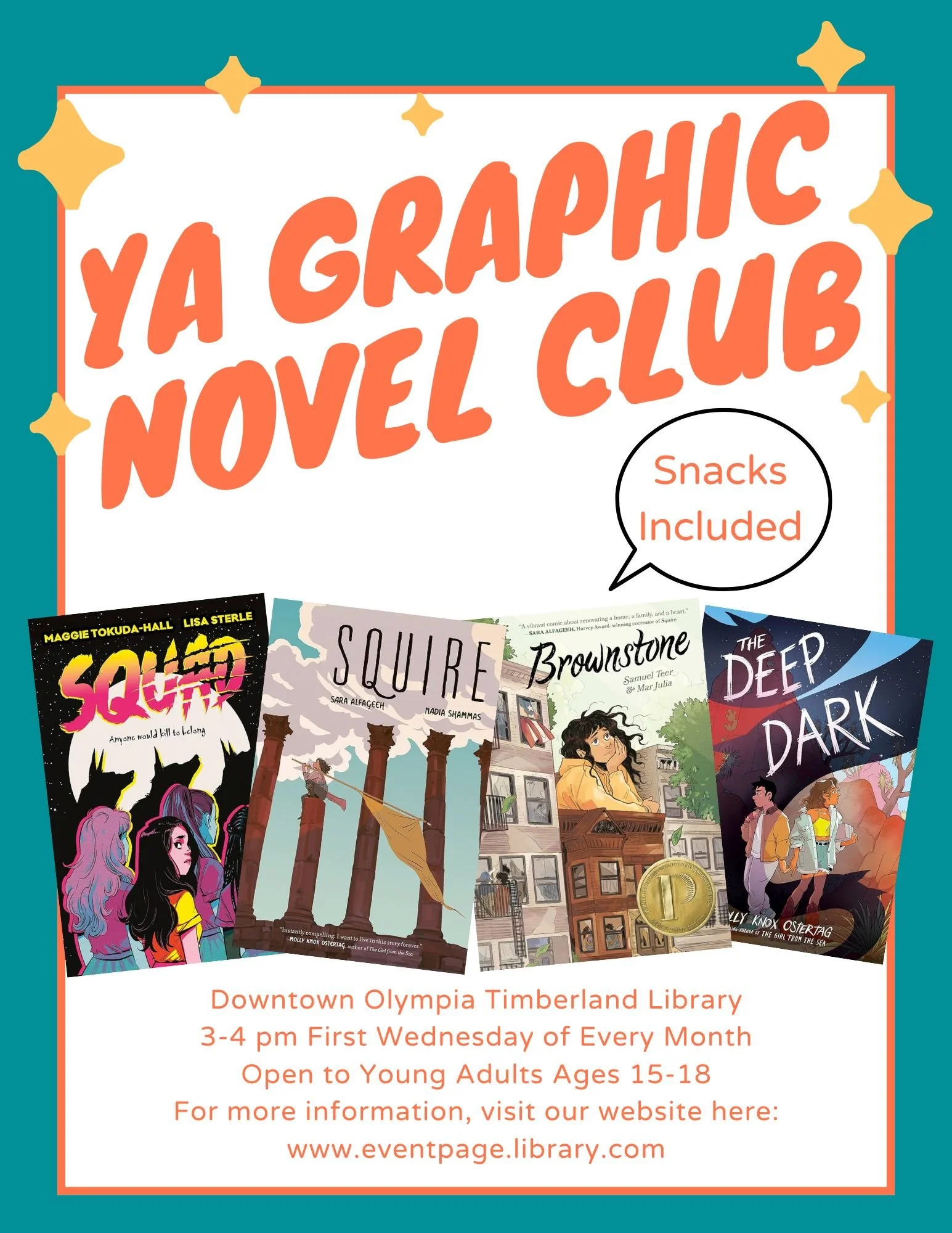
YA Graphic Novel Book Club
Mock Up Programming from MLIS Coursework
Justification
Graphic novels have become increasingly popular over the last several years. A study done by the School Library Journal surveying school librarians and youth services librarians found that the format's popularity rose by over 90% percent in the last few years. Additionally, graphic novel sales have only kept growing since the early 2000’s. In 2007, graphic novel and manga sales climbed to $375 million (Holston, 2008). In 2025, comic and graphic novel sales were estimated to be $2.2 billion (Alverson, 2026). With numbers like that, there’s no denying the format's popularity. Graphic novels, manga, and comics are more popular than ever, so library programming dedicated to engaging with graphic novels is a great way to reach younger patrons who might not otherwise participate in library events or activities.
There are numerous benefits to graphic novel programming. For one, graphic novels are a great way to reach reluctant readers, people who, for one reason or another, choose not to read. Teens are pulled in so many different directions on a day-to-day basis. Teens contend with a myriad of shifting interests and responsibilities. Not only are there high school and the myriad of assignments and classes they attend, but many teens also juggle extracurriculars like sports or music, as well as familial responsibilities and social entanglements. There’s also a plethora of entertainment for teens. Video games, movies, shows, and the internet are all vying for teens' attention, so picking up a book is at the bottom of the priority list for many teens. Graphic novels are a great way to reach teenage reluctant readers, exactly because teens nowadays predominantly consume visual media (Clare, 2005). Recent generations who grew up with the internet live in a highly visual world, therefore making them more attuned to visual media. A reluctant reader who doesn’t often stretch their literary muscles will have a hard time understanding and enjoying a traditional book, so the visual aspect of graphic novels helps bridge that gap. In graphic novels, readers watch the story unfold in real time, making the translation from page to brain increasingly seamless. This helps make graphic novels more accessible and enjoyable to a wider variety of teenage readers.
Graphic novels are also an excellent avenue to engage teens in social justice issues. In her article Visual Impact: Comics and Social Justice Amy Brownlee dives into the benefits graphic novels have on young people's social awareness and engagement. Brownlee finds that “When students read a graphic novel dealing with social justice issues, they build empathy for people and learn to see things from a new point of view.” (15). Graphic novels are a direct window into other people’s experiences. Readers literally see the injustices and hardships marginalized people live with in graphic novels, confronting them firsthand with experiences outside their own, and putting themselves directly in another person's shoes. Arguably, one of the first steps towards cultural awareness and social justice engagement is understanding the inequities and discrimination marginalized people face. The visual medium of graphic novels, comics, and manga is a stellar way to start teenagers on this path.
Engagement Strategies
Incorporating teen input into the program will be crucial to its success. Amanda Lawrence speaks on how she included student feedback in her middle-grade graphic novel club in her article Hosting a Middle-Grade Graphic Novel Club, saying,“At our first gathering, I polled the kids to find out what graphic novels and series they already loved… knowing their interests helped me determine what they might want to read next” (17). For a young adult book club, I would take this strategy even further by asking attendees for graphic novel recommendations for future club meetings. I would vet the titles beforehand and even have the book club members vote on a short list of titles in order to decide future book club picks. That way, the teen attendees would have direct input into the program and feel more invested in the book club as a result. Stakeholder interest is especially important when it comes to teen programming.
It’s also important not to strictly adhere to any preset discussion questions and instead follow the threads and themes that the teens bring up themselves during book club. Discussion questions are best used as backup or to start new conversations when there’s a lull in the discussion. Following the teens' interests and asking questions more organically is best in order to support teens' interests and connect with them on their level.
Program Details
The title for the program will be “YA Graphic Novel Club”. It is short and self-explanatory, capturing the essence of the program in only a few words. I am constructing this plan as if it were being held at my local library, the downtown Olympia Timberland Library. The book club will be held once a month on Wednesdays after school from 3-4 pm because the local high school has an hour early release at 2:35 every Wednesday. It would slot well into teens' schedules and not take up valuable weekend time. Naturally, there will also be snacks. From my personal experience working with teens, food is a big motivator and draw for many teens, and could possibly pull in any teens who would otherwise be on the fence about attending a book club.
Working Schedule:
3-3:10 Soft start. Teens file in and the group chats while I pass out snacks
3:10-3:15, gather everyone’s attention, briefly introduce the book, and start the discussion with one of the discussion questions.
3:15-3:45 continue discussion. Introduce more discussion questions if the conversation starts to lag.
3:50-45 brief reminder that we have 10 minutes left. Check in and discuss with the group about next month's book club pick. Introduce voting on book club pics in this time slot in a few months, once the club is more established.
Budget
As for the budget, getting enough copies for all attendees each month is the biggest hurdle. Adam Kullberg recommends in his article Starting a Virtual Graphic Novel Book Club to “...consider reaching out to publishers, requesting donations, applying for small grants, and/or partnering with local bookstores and comic shops to get affordable access to titles ”(22). I will explore all avenues of financing before even starting the book club. Extra copies of the book will be readily available to teens who register for the event.
Outcomes
There are a handful of desired outcomes for this program, with social bonding and a positive attitude towards libraries/reading being the top two. I would be ecstatic if teens made new friends as a result of attending the program. Or even found a new avenue to connect with current friends, family, or teachers. This pairs well with developing positive feelings towards libraries/reading. If teens are meaningfully bonding with their peers over graphic novels, that positive association they feel towards their peers will intrinsically be linked to libraries and reading. This makes it more likely that teens will continue coming back to the library for other resources and events as they age.
Additionally, teens will develop critical thinking skills and build their awareness of social justice issues as a result of the book club. Through intentional book club picks and guided discussion, teens will be encouraged to analyze themes, evaluate different perspectives, and consider how the experiences depicted in graphic novels connect to real-world issues. As mentioned earlier in the justification section, graphic novels combine visual and textual storytelling and are therefore an accessible entry point for discussing complex topics around identity, equity, community, and representation. Exposure to these perspectives can help participants reflect and broaden their understanding of the diverse communities around them. This program will allow teens to stretch their critical thinking muscles while building positive relationships with both their peers and the library.
Evaluation
The success of the program will be measured both formally and informally. Attendance numbers are a solid place to start. If the program maintains or increases the number of people attending each month, I would consider the program a success. Informally having conversations with attendees in order to gauge their thoughts and perspectives on the book club is also a good way to measure success. If their feedback is positive on the whole, the program is successful. If feedback is negative, I can take teens’ observations into account and use their feedback to improve the program and tailor it to the interests and needs of the teens actually attending the book club.
Reflection
Since this program is a solo endeavor, planned and run exclusively by me, I think it will be helpful to seek out advice and feedback from fellow librarians to inform my own reflection. Talking over engagement strategies, program logistics, as well as how the book club is faring on the whole with other librarians within my sphere will help me gain perspective on how successful the program is and how I might change the book club to reflect the needs of teen attendees. Additionally, I would benefit from having a more experienced librarian attend a book club meeting as an observer and provide constructive feedback based on their assessment of the program.
Starting Titles and Discussion Questions
The Deep Dark by Lee Knox Osterdag
Mags has a secret in her basement…and it has fangs. While Mags is struggling with heavy responsibilities, an old childhood friend, Nessa, comes to town to reconnect. While Nessa and Mags reflect on their past and come to be more than friends, Mags finally comes to accept all parts of herself, even the ugly, monstrous ones. Knox Ostertag is a veteran graphic novel writer and artist with numerous outstanding middle-grade and YA graphic novels under his belt. The Deep Dark is a rich and engaging story that fully utilizes its graphic format. With a unique blend of color and black-and-white images, this book is ripe for discussion. Did I mention The Deep Dark won a Prinz honour in 2025!
Questions:
What does “the thing in the basement” represent in Mag's life? Why is she compelled to keep it hidden?
How does the title of the book, The Deep Dark, connect with the story and characters? What is the title referring to?
While the present timeline is mostly portrayed in black and white illustrations, there are hints of color here and there. What does the varied use of color represent in the book? How does it enhance or detract from the story?
How do secrets impact the different characters in the book? What does it take for different characters to share their secrets?
How does the ending of the book and Mags' acceptance of the creature affect her identity? How does it affect her self-image and relationship with other characters?
How do guilt and the feeling of being needed play a role in different characters' lives?
Squire by Nadia Shammas and Sara Alfagee
In the Bayt-Sajji empire, Aiza is a second-class citizen because of her Ornu descent. With dreams of joining the army to become a squire and eventually a famous and renowned knight, Aiza covers the tattoos that all Ornu carry and enlists. This stunning fantasy graphic novel uncovers the harmful systems behind imperialism and empire as Aiza and her friends participate in and then fight back against the Bayt-Sajji empire. Squire won the Harvey Award (one of the comics industry’s oldest and most prestigious awards) for best children’s and young adult book in 2022. This story is an excellent book club pick because of its deft handling of themes around empire, nationalism, and the cycle of violence. The stunning art and compelling characters make this book an excellent pick for any YA book club.
Questions:
Aiza’s mother asks Aiza to cover up her Ornu tattoo before she heads off for squire training. Why does she do this? How would the book have changed if Aiza hadn’t covered up the tattoo?
Aiza, Husni, Sahar, and Basem all have different backgrounds and experiences, but they all want to become squires. Why are they each reaching for this goal? What are their motivations?
How do the different characters' varied backgrounds and identities inform how they see each other? What are their biases?
What does the blade Aiza is gifted by General Hende in chapter 10 represent?
How do the illustrations add or detract from the story?
In Nadia Shammas’ Squire and History note at the back of the book, she says, “In Squire, history is as much a weapon as Aiza’s blade”. How is history and information used by different characters in the book?
Bibliography
Alverson, Brigid. “ICv2 White Paper: Comics and Graphic Novel Sales Reached New High in 2025.” ICv2, ICv2, 6 Feb. 2026, icv2.com/articles/news/view/61573/icv2-white-paper-comics-graphic-novel-sales-reached-new-high-2025.
Brownlee, Amy. “Visual Impact: Comics and Social Justice.” School Library Journal [New York], vol. 71, no. 5, May 1, 2025, p. 15.
Cockcroft, Marlaina. “Graphic Novels, Manga Explode in Popularity among Students | SLJ Survey.” School Library Journal, 3 Oct. 2023, www.slj.com/story/Graphic-Novels-Manga-Explode-in-Popularity-Among-Students-SLJ-Survey.
Holston, Alicia, and Tuan Nguyen. “The Maverick Graphic Novel List: Unmasking the Mystery of Comics and Graphic Novels for Libraries.” Texas Library Journal, vol. 84, no. 3, October 2008, pp. 92–95.
Kullberg, Adam. “Starting a Virtual Graphic Novel Book Club.” The Booklist [Chicago] vol. 31, no. 3, March 2022, pp. 20–23.
Lawrence, Amanda. “Hosting a Middle-Grade Graphic Novel Club.” The Horn Book Magazine [Boston], vol. 99, no. 5, September 1, 2023, pp. 16–20.
Snowball, Clare. “Teenage Reluctant Readers and Graphic Novels.” Young Adult Library Services [Chicago], vol. 3, no. 4, July 2005, pp. 43–45.